
Front Door Stories - Hof ter Putten
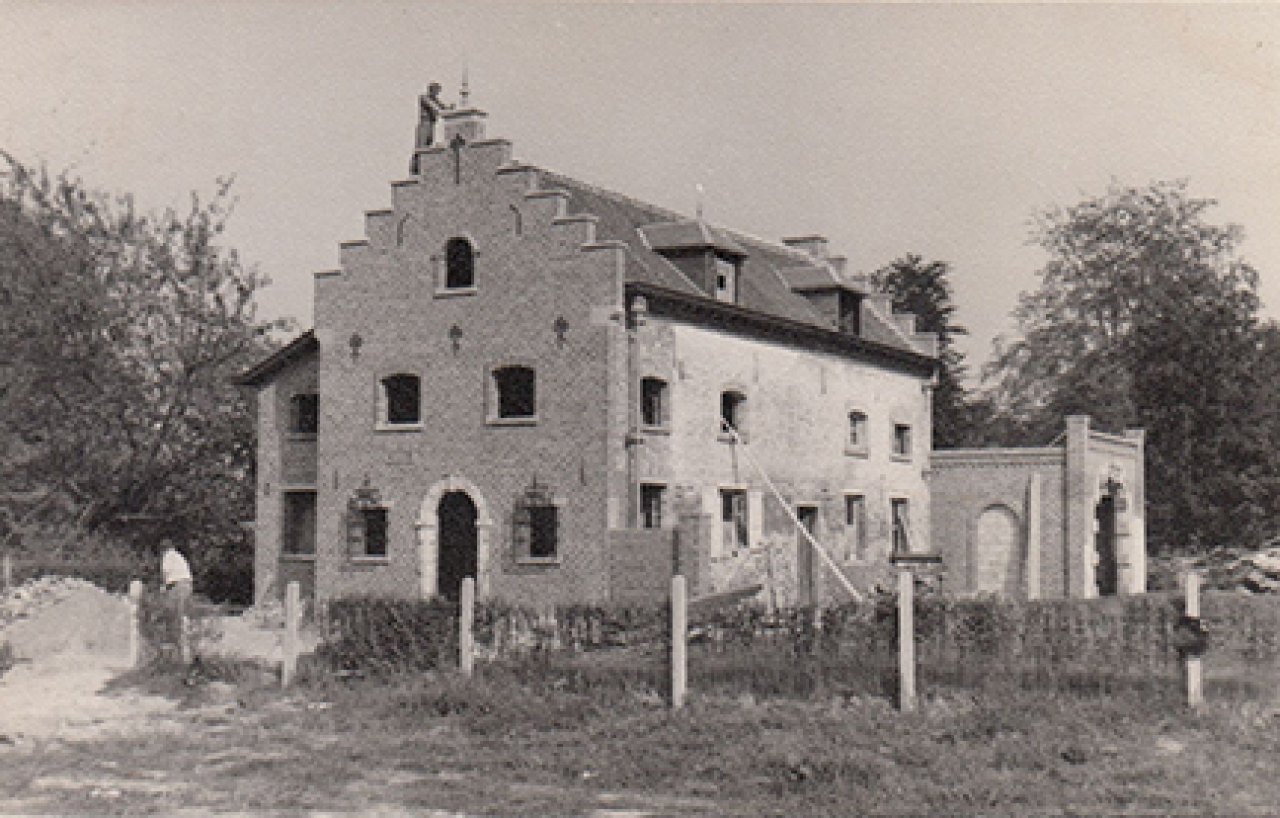
The real estate firm Pajota has begun renovating the “Hof ter Putten,” located in the center of Dilbeek. The original building dates back to the late 18th century. Pajota will restore it to its former glory and expand it with an ultra-modern wing so that it can serve as the headquarters for its offices.
“Hof ter Putte” takes its name from the old wells in the backyard. It is located at one of the old quarries in Dilbeek, where Lediaan stone was quarried until around 1490. In the late Middle Ages, this stone was used to build large mansions, castles, town halls, and churches.
Many well-known churches were built using stone from the Dilbeek quarries. These include the local St. Ambrose Church, as well as St. Gudula’s and St. Michael’s Cathedrals and the Kapellekerk in Brussels. Dilbeek stone was also used in Antwerp’s Cathedral of Our Lady and even in St. John’s Church in ’s-Hertogenbosch.
Studies also show that Leuven City Hall, which celebrated its 450th anniversary in 1998, was built using stone from the Dilbeek quarries. “Behind the Hof ter Putte are the gigantic pits of the old quarries, so it’s not unlikely that a significant portion of Leuven’s city hall was located right in our backyard,” laughs Thomas Valkeniers, manager of Pajota.
He bought the building two years ago because he loved it. “The building was slightly run-down and stood discreetly behind many bushes and trees. Restoring it to its former glory seemed like a fun and financially feasible project to me. We have four children and thought it might be suitable for one of them. When several longtime residents came to tell me about its historical background, and I began to appreciate the building’s beautiful details more, my wife and I decided to make it the headquarters for our offices. This way, the building will be open to the public.”
“Hof ter Putte” is mentioned in archives as early as the 14th century. It also appears on the Ferraris Map (1771–75) and on G. de Wautier’s “Carte topographique de Bruxelles et de ses environs” from 1811, where a U-shaped building can still be seen. Around 1830, the old country house belonged to the Emmerechts family and still covered 6 hectares. In 1835, “Hof ter Putte” was sold to Gaspard Moeremans. He had the old country house demolished and built a new, large castle, which is now the castle of the “Maria Assumpta” retirement home.
“So the original Hof ter Putte was demolished,” explains Thomas Valkeniers. The building we are currently restoring is believed to be the old gatekeeper’s house. Unfortunately, there are no old photographs or traces of the building in the archives. It was enlarged during an initial renovation long ago. The house was also once inhabited by an antique dealer who brought in antiques from other buildings. “That makes it very difficult to reconstruct everything,” says Thomas Valkeniers. “I would be happy to hear from anyone who can tell me something about the building’s history.”
“We want to preserve the history as much as possible. The architect was therefore instructed to connect the extension to the existing building at only one point. This way, the original building is preserved, and we can easily repurpose the building later on. The renovation is being carried out by architect Bart Lens. He is a specialist in this field who has already won several national and international awards. We hope to complete the project by the end of 2013,” concludes manager Thomas Valkeniers.